


- View cart You cannot add that amount to the cart — we have 1 in stock and you already have 1 in your cart.


Rare and Unique Roaring Lion Head Pioneer Sapper Sword
A rare and unique roaring lion sapper's or pioneer's sword. Beautiful bronze work on the lion's head showing his teeth, mane and other facial features. The s-shaped guard features snake heads on each side. Might be German Faschinemesser but also resembles sword designs from France and Italy. Too ornate to be issued to a regular soldier, probably custom made for a wealthy one. The blade has two holes where handles can be fitted, or a rope, to be used as a saw by two people. Early 1800's. No scabbard. The blade is marked and heavy since these were used as hatchets to clear the way for infantry, and the saw on the spine is all in tact.
A rare find. I couldn't find any other like it online.
Length: 85.5 cm / 33.66 inches
Weight: 1.350 Kg / 2.97 lbs.


British 1856 Pattern Pioneer Sapper Sawback Short Sword
A British pattern 1856 pioneers short sword, with heavy straight saw-backed blade and brass ribbed hilt with rounded knuckle bow and downturned quillon. Comes with the original leather and brass scabbard. In very good condition. The blade is shows the British government and inspection marks, including the broad arrow, crown inspection stamps and others.
Length: 70 cm / 27.5 inches
Weight: 1.4 Kg / 3 lbs.


French Napoleonic Era Rooster Head Sapper’s Sword
A French Napoleonic era sapper’s sword, or pioneer sword, early 19th Century. Sappers were the combat engineers of the era, also know to be named pioneers since they were the first to go into enemy terrirtory alongside infantry and cavalry units in the Napoleonic wars clearing the way for the forces to move forward, building shelters and trenches, cutting down trees and dismantling enemy defenses.
Heavy blade with patina, displaying a crowing Gallic rooster head pommel and brass crossguard embossed with lion and dog heads.
The sword does not come with a scabbard.
Length: 100 cm / 40 inches
Weight: 1.5 kg / 3.3 lbs.


Cane Sword with Dante’s Head


Sword Cane Walking Stick with Mythological Creature’s Head


Sword Cane with Lion Head Victorian Indian Colonial Style
Sword cane with lion head Victorian Indian colonial style with short blade and carved bone on handle. Lion head sword cane with short blade for sale. The sword opens with a brass 'twist and lock' action to keep the blade in the cane and re-twist to unlock etc. Some staining due to age on the blade as seen in the photos.


African Azande Mambele Sickle Sword
African Azande Mambele sickle sword of the Democratic Republic of Congo. These African sickle swords have a wide variety of forms and are found over a wide area north-east Congo, among the Bandia, Benge, Mongelima, Nzakara, Zande, Boa and Mangbetu tribes. There is no consensus as to which form can be associated (if at all) with a particular group. This variety is commonly called Azande.
Late 19th to early 20th century.
Length: 75 cm / 29.5 inches
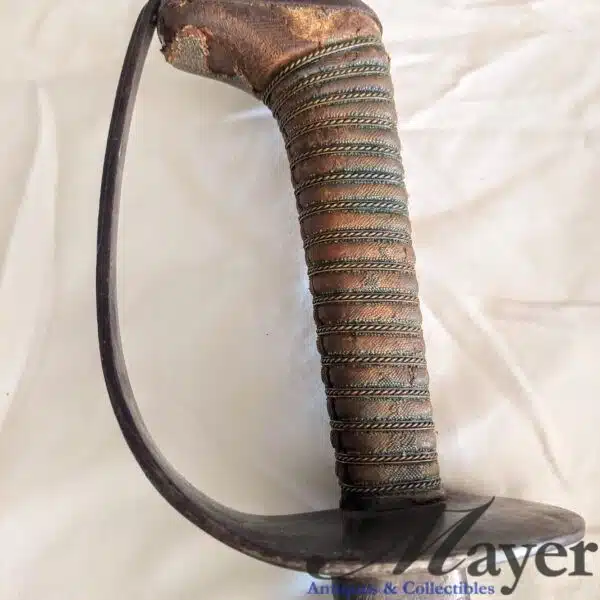

Original US Rare M1905/06 Experimental Patton Saber by Ames Sword Co.
Original US 1905/1906 experimental saber by Ames Sword Company in Massachusetts. The bird-head like grip allowed for a better grip especially while riding. A.S. Co., ordnance bomb and 1906 on one side of the ricasso and US on the other side. The grip is made of sharkskin with the wires wrapped around. A bit of damage on the bottom of the grip where a small piece of sharkskin has been taken off. The blade is in good condition with blemishes from age since this piece is more than 100 years old. The scabbard is probably made of pig skin and has shrunk over time exposing the wooden pieces constructing the scabbard. The fact that this sword comes with its scabbard is very rare.
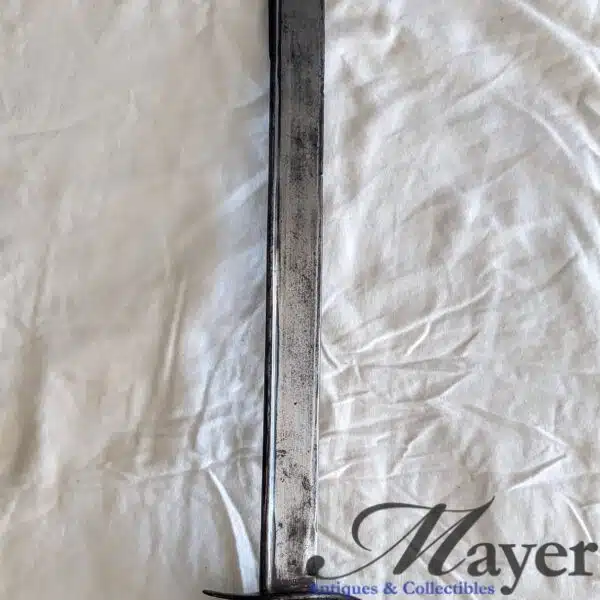
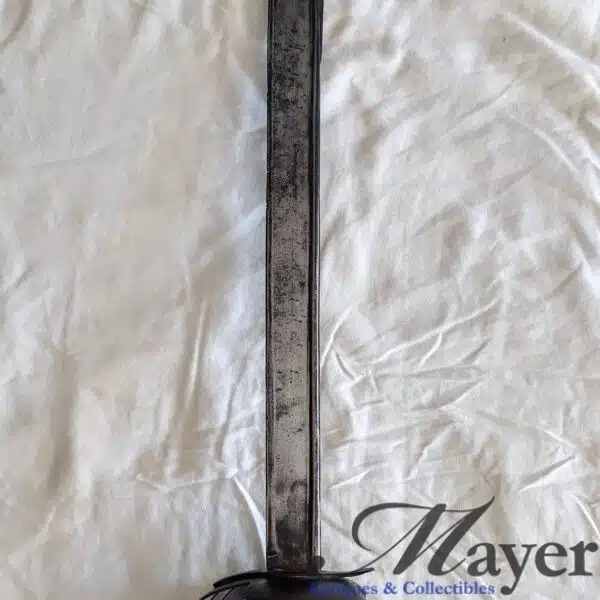
Austrian Marine Naval Cutlass Sword Model 1858 by FS Jung
Austrian Marine Naval Cutlass Sword Model 1858 used mainly for marine naval warfare while boarding enemy ships. The cutlass is easy and smooth to wield with a very good balance, suited for fighting in close quarters. In Austria this cutlass sword was called “Entersabel” or “Bordsabel”. Up until 1858 the Austrian Navy used French captured cutlasses and in 1858 ordered its original design which remained in service till 1904. On ships it was used mostly as a working tool for general use thus the scabbards are missing on most pieces and are extremely rare.
The sword has a thick and forward heavy pipeback blade, a basket guard as for this kind of weapon. Produced by FS Jung with a mark of a cross surrounded by four smaller crosses. Dated 1858.
No scabbard.
Grips have damage but blade and the rest of the sword are in very good condition.
Measurements
76 cm / 30 inches
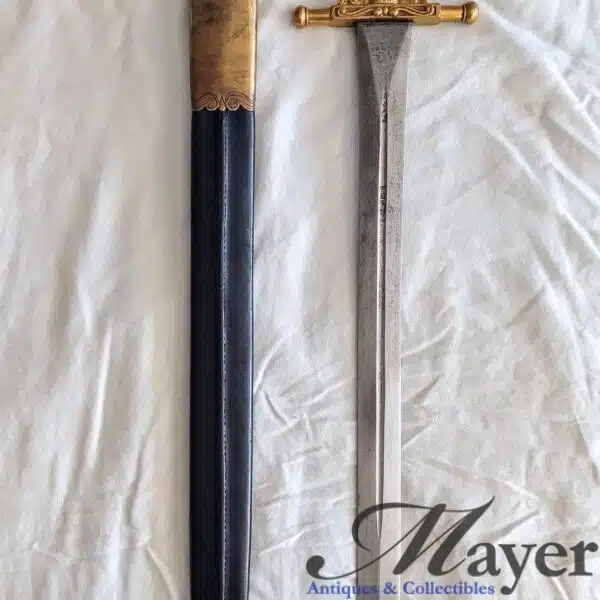
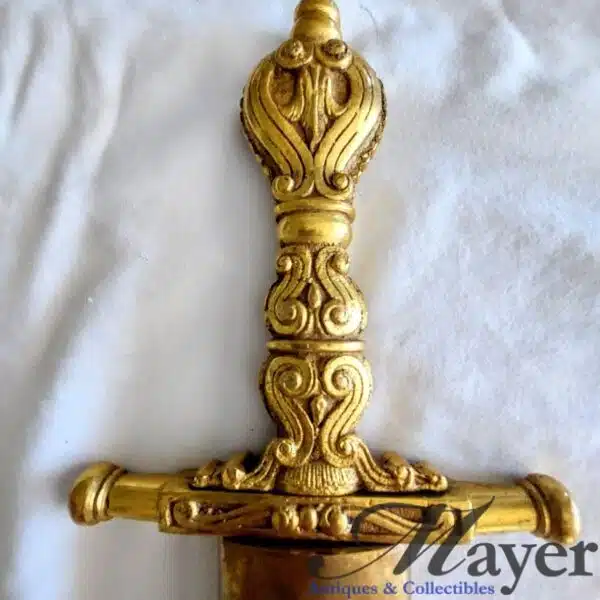
Royal Company of Archers Long Sword By Skinner & Co.
Rare Royal Company of Archers long sword from the 19th century carried by the Queen’s Body Guards for Scotland. Straight double edged blade, etched with floral decoration and marked Skinner & Co. Jermyn St. London. Ornate golden gilt cross guard decorated with floral design. Original scabbard with floral design fittings. This Royal Company of Archers long sword is in very good condition with minor blemishes as a result of its age.
Measurements
Total length with scabbard: 67.5 cm / 26.5 inches
Total length of sword: 64.5 cm / 25.3 inches


Russian 1827 Pattern Pioneer Troops Sawback Sword
Original Czarist Imperial Model 1827 Pioneer Sawback sword. These were the standard sidearm sword for Russian Pioneer Troops during this period. Marked 1832 with various proof marks. Blade is with serrated sawback and curved blade with cutlass blood groove. This sword does not come with the scabbard.


Authentic Moro Kris Sword
An authentic Moro Kris short sword from the Southern Philippines. The Moro Kris is a rugged fighting blade that was mostly used in the Mindanao area of the Philippines. The hilt, scabbard and blade are decorated with copper or brass decorations and the blade features a serpent or dragon like design. The Moro people or actually Bangsamoro people, refers to the 13 Islamized ethnolinguistic groups of Mindanao, Sulu, and Palawan regoins. The Moro fought against the Spanish invaders in the early 1500's using these short swords but the design of the blade itself is actually from pre Islamic influence era. The wavy blade symbolizes the Naga; a mythical serpentine dragon that was worshipped in the animistic days of Malay history.