Welcome To Mayer Antiques & Collectibles


Rare and Unique Roaring Lion Head Pioneer Sapper Sword


British 1856 Pattern Pioneer Sapper Sawback Short Sword


French Napoleonic Era Rooster Head Sapper’s Sword


Rare Israeli K98 Mauser M49 Presentation Bayonet


Israeli Military Surplus Captured Polish AKM Bayonets


Military Surplus & Used Optics Lot
| Description | Quantity |
| Elbit-ITL modified Zeiss fero modell z-51 x5 with m15/16 mount | 1 |
| EZ TAP USA 3-12-50 | 1 |
| HAKKO JAPAN 4-2 | 1 |
| HAKKO JAPAN BOOSTER X2 | 2 |
| HERTEL & REUSS OPTIK ,KASSEL ,MACRO-VARIABLE, 2-7 ,WITH A SPECIAL MOUNT | 1 |
| KAHLES WIEN – HELLIA SUPER 39S2 3-9-42 | 2 |
| KAHLES WIEN – WW2 6-40 ,WITH K98 MOUNT. | 1 |
| KAHLES WIEN ZF 69 6-42 ,WITH G3 MOUNT. | 1 |
| KARL KAPS AUSTRIA , ASSLAR / WETZLAR 1-5 , WITH ORIGINAL G3 MOUNT. | 1 |
| LEAPERS USA 6-24-50 AO | 1 |
| MILITARY SCOPE 2-17 | 1 |
| NICKEL MARBURG 6-9-50 | 1 |
| ORTEK – HITEYE X1.5 WITH M-16 QUICK MOUNT | 5 |
| Ortek Starlight Scope AN/PVS-2 Starlight Scope with mount for M1919 or MAG58 | 1 |
| PGO-7W 2-73 SCOPE WITH INTEGRAL RPG AND DRAGUNOV MOUNT | 1 |
| TASCO USA , PRONGHORN 4-32 | 2 |
| TRILUX SCOPE WITH INTEGRAL 0.3 BROWNING MG MOUNT | 1 |
| WEAVER USA D4 | 1 |
| ZEISS DIVARRY,AUSTRIA 3-10 | 1 |
| ZEISS JENA AUSTRIA ZF 6-42 M DDR | 1 |
| ZEISS DIATAL-D 4-32 | 1 |
| ZUIHO JAPAN 6-31 with K98 mount | 1 |
| 29 |


WW1 Trench Art Pair of Decorative Artillery Shells
Visual & Historical Breakdown
1. The Inscription: “YSER”
The most prominent feature is the banner reading YSER.
-
The Location: This refers to the Yser River in West Flanders, Belgium.
-
The Significance: This was the site of the Battle of the Yser in October 1914. Belgian and Allied forces famously flooded the area to stop the German advance. The Yser front became a symbol of Belgian resistance throughout the war.
2. The Heraldic Shield
The central shield is highly detailed and divided into two parts (impaled):
-
Left Side: Features a sunburst or geometric pattern, likely representing a specific military unit or a stylized version of a regional crest.
-
Right Side: Displays a Rampant Lion, which is the national symbol of Belgium (and also specifically the region of Flanders).
-
The Crown: The shield is topped with a royal crown, indicating Belgian national or monarchist pride.
3. The Dates & Decor
-
1914 – 1918: These dates are embossed on banners at the base of the design, commemorating the entire duration of the Great War.
-
Floral Motifs: The shield is framed by laurel leaves (victory) and oak leaves (strength), traditional military symbols.
-
Repoussé Technique: This was created using a technique called repoussé and chasing, where the soldier hammered the brass from the inside of the shell casing to create a raised 3D design on the outside.
Primary Military Markings
-
18 PR: This identifies the caliber. It stands for 18-pounder, the most widely used British field gun of the Great War.
-
II: The Roman numeral indicates the “Mark” or version of the shell casing design (Mark II).
-
1915 / 1916: These are the years of manufacture.
-
CF: This stands for Cordite Full. It indicates the shell was filled with a full charge of cordite propellant.
-
Broad Arrow (↑): You can see this small arrow symbol on several shells. It is the “King’s Mark” or War Department Arrow, signifying that the item was official British government property.
Manufacturer & Inspection Codes
-
M.A.C.: Likely the manufacturer code. While many companies produced these, common makers included the Metropolitan Ammunition Company.
-
J.C.: An inspector’s or manufacturer’s stamp.
-
M.L.W.: Another manufacturer or facility code.
-
Numbers like “17.1.10.15”: This is often a specific lot number or a precise date of inspection/assembly (e.g., October 15, 1915).
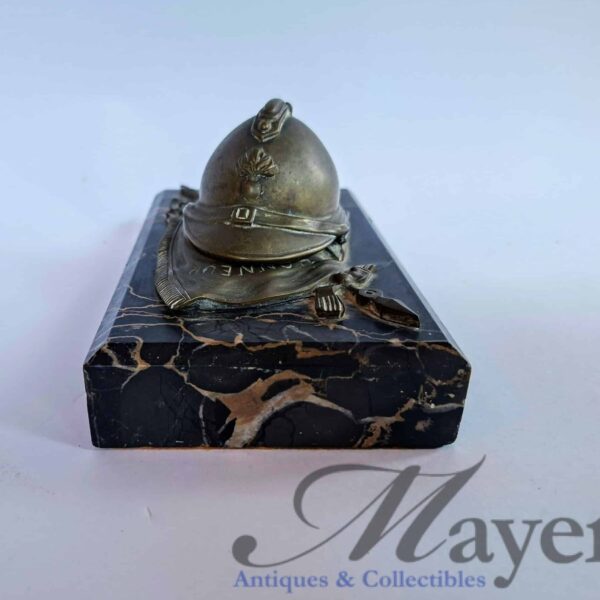

French WW1 Helmet Inkwell Trech Art
-
The Adrian Helmet: The lid is shaped like the standard-issue French Casque Adrian.
-
The Base: A dark, veined marble base.
-
Symbols: On the left, there is a laurel or oak branch (symbolizing victory or strength). On the right, a draped flag bearing the word “Honneur.”
Online Antiques Shop – Updates, News & Events

The Art of the Untouched: Why History Hunters Choose Mayer Antiques & Collectibles


Decorate Your Man Cave with Unique Antiques and Collectibles

Militaria Antiques and Collectibles: A Deep Dive into Edged Weapons, Bronze Sculptures, and Historical Treasures

Historical Militaria Plaques and Statues for Collectors
Please check your inbox to confirm your subscription
Will be used in accordance with our Terms & Conditions